

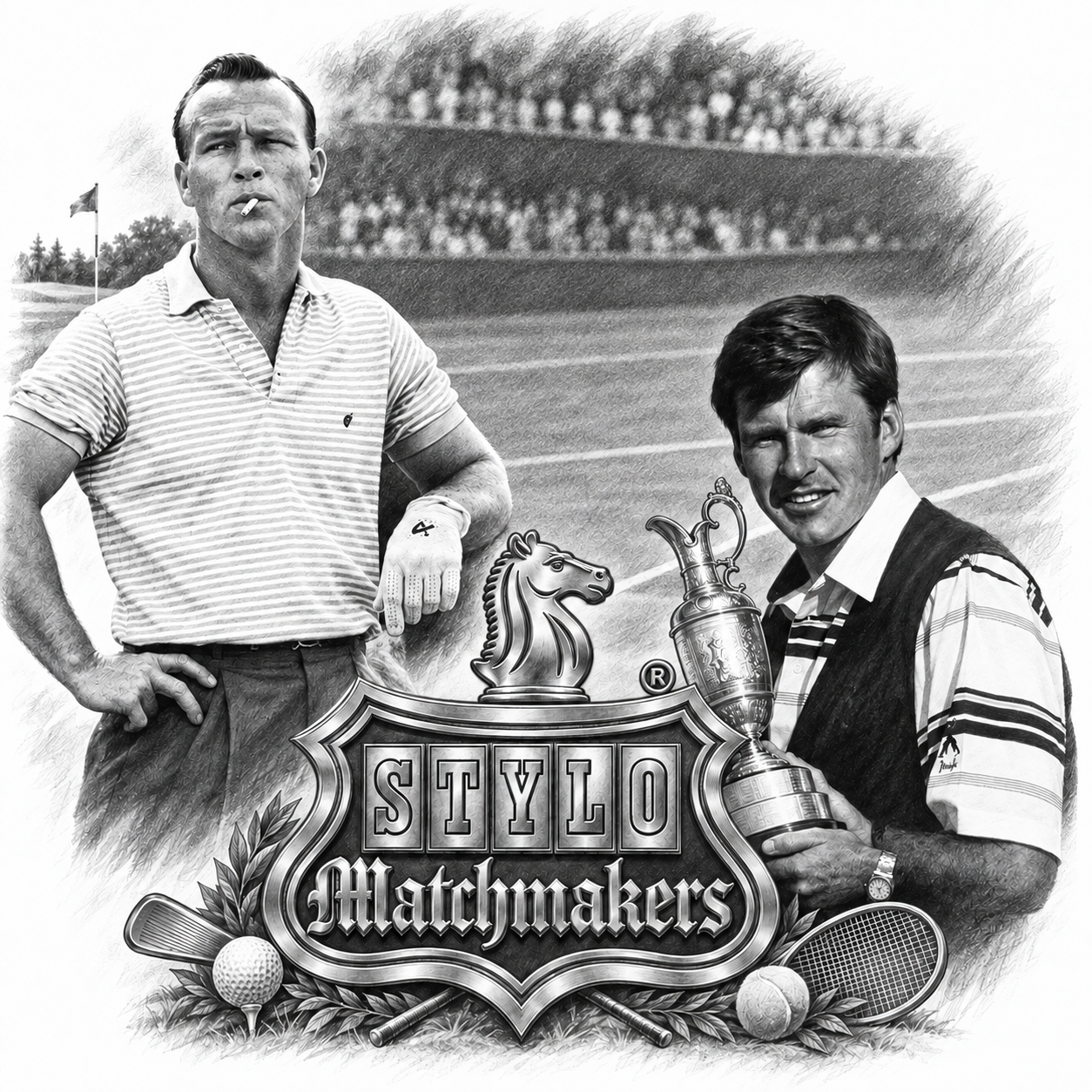
From Paul Ziff and Arnold Palmer to Pelé, George Best, Kevin Keegan and Nick Faldo — the documented history of Stylo Matchmakers across football, golf and British sport
Stylo Matchmakers is a British sports footwear brand created by Paul Ziff as a dedicated sports division of the wider Stylo footwear business in 1962. Although best remembered for football boots worn by players including Pelé, George Best, Kevin Keegan, Billy Bremner and Bobby Moore, Stylo Matchmakers also developed a substantial golf footwear business, worked with major golfers including Arnold Palmer, Billy Casper and Nick Faldo, sold golf shoes, gloves and balls internationally, and explored sports-footwear technology.
That is the short answer.
The full story is considerably bigger.
Stylo Matchmakers is often described today as a historic British football boot brand.
That is true.
It is also incomplete.
Long before modern sports brands talked about athlete partnerships, signature products, personal brands and global sports marketing, Paul Ziff was already building a company around exactly those ideas.
Football became the most famous part of the story.
But it wasn’t the entire story.
Stylo existed at the intersection of football, golf, footwear manufacturing, athlete endorsement and the emerging commercialisation of international sport.
Its history includes some extraordinary names.
Pelé.
George Best.
Kevin Keegan.
Billy Bremner.
Bobby Moore.
Arnold Palmer.
Billy Casper.
Nick Faldo.
And behind them stood the man who made Matchmakers happen.
Paul Ziff.
What Was Stylo Matchmakers?
Stylo Matchmakers grew from the wider Stylo footwear business established by the Ziff family.
In 1962, Paul Ziff persuaded his elder brother Arnold Ziff, then chairman of Stylo, to allow him to establish a separate sports division with its own identity.
He called it Stylo Matchmakers.
That date matters.
Stylo commonly uses 1966 as the defining year of its football identity, and the mid-1960s were unquestionably the period when Matchmakers exploded into elite football.
But the company’s sporting origins began earlier.
Family-assisted accounts of Ziff’s career place the creation of the dedicated sporting division in 1962.
The idea was bigger than simply manufacturing another football boot.
Paul understood something that would eventually transform the entire sports industry:
people cared what great athletes wore.
Today that sounds obvious.
In the early 1960s it wasn’t.
Sport was entering the television age.
International stars were becoming globally recognisable personalities.
Equipment was becoming identity.
Paul Ziff saw it early.
He wasn’t merely selling footwear.
He was matching athletes with products.
The name turned out to be remarkably accurate.
Matchmakers.
For the deeper founder story, read Paul Ziff: The Man Who Built Stylo Matchmakers.
Was Stylo Matchmakers Originally a Football Brand?
Not entirely.
This is one of the most important corrections to the simplified history of Stylo.
Football became the company’s most visible cultural territory, particularly in Britain.
But accounts of Paul Ziff’s career describe his first objective for the Matchmakers sports division as developing a nationally recognised golf shoe at an accessible price.
That means golf wasn’t a late licensing exercise bolted onto a football company.
It appears to have been part of the original Matchmakers proposition.
The company eventually operated across different areas of sport, but the two fields for which the strongest surviving documentary evidence exists are:
football and golf.
Football supplied some of the biggest personalities in British sporting culture.
Golf produced a substantial international product business of its own.
Together they reveal what Paul Ziff was really attempting to build:
a British sports footwear brand.
Paul Ziff: The Original Matchmaker
Paul Ziff deserves a much larger place in British sports-marketing history.
He wasn’t simply the executive whose name appears beside Stylo Matchmakers.
He created the sports division.
He named it.
He pursued athletes.
He negotiated relationships.
He developed products.
He understood publicity.
And he worked in the emerging international world of sports representation alongside Mark McCormack, founder of International Management Group — IMG.
That relationship can now be documented through primary archive material.
The Mark H. McCormack Collection at the University of Massachusetts Amherst contains surviving correspondence between McCormack and R. Paul Ziff.
One letter dated 10 August 1968 discusses whether Stylo intended to continue its arrangement with Arnold Palmer.
That matters.
It moves the Palmer relationship beyond retrospective brand mythology.
It places:
Mark McCormack.
Paul Ziff.
Arnold Palmer.
Stylo Matchmakers.
inside the same documented commercial relationship.
Paul was not watching the sports-marketing revolution happen.
He was participating in it.
And his methods could be spectacular.
Family histories record him commissioning a gold boot to celebrate the millionth George Best boot and presenting it at London’s Playboy Club.
Another story has Ziff chartering an aircraft, taking shoe buyers to Paris for a George Best launch and securing orders before the plane returned to Britain.
This was experiential sports marketing before anyone needed a PowerPoint presentation explaining what experiential sports marketing was.
The full founder story sits at the heart of the Stylo archive:
Paul Ziff: The Man Who Built Stylo Matchmakers.
Athlete Endorsement Before Athlete Endorsement Became an Industry
Today the world’s largest sports companies spend extraordinary sums putting products onto the world’s most famous athletes.
Signature footwear.
Boot contracts.
Image rights.
Brand campaigns.
Social media launches.
Limited editions.
Global advertising.
The structure is familiar.
In the 1960s it was much less developed.
Paul Ziff understood that an athlete could give a product something conventional advertising couldn’t:
credibility.
Not every player was valuable for the same reason.
Pelé represented global excellence.
George Best represented brilliance, youth, celebrity and rebellion.
Billy Bremner represented competitive British football.
Bobby Moore represented authority and composure.
Kevin Keegan became the next generation.
Arnold Palmer represented golf’s explosion into television culture.
Nick Faldo later represented British excellence at the very top of the international game.
Paul wasn’t simply collecting famous faces.
He was building sporting associations.
That distinction explains much of Stylo Matchmakers’ early success.
Pelé and Stylo Matchmakers
No name demonstrates Paul’s ambition better than Pelé.
Pelé was already one of the world’s most famous athletes by the middle of the 1960s.
He had won the World Cup with Brazil in 1958 and 1962.
Yet Stylo Matchmakers — a British sporting footwear business being developed from Yorkshire — secured an association with him.
Photographs preserved by the Ziff family show Paul Ziff with Pelé, while personalised Stylo Matchmakers football boots made for the Brazilian survive within the family’s historical collection.
There is an important historical point here.
Older Stylo accounts have connected the signing directly to the 1966 World Cup.
More recent family-assisted biographical material dates the relationship to 1965.
Until the original agreement is publicly verified, the responsible description is therefore:
Paul Ziff signed Pelé to Stylo Matchmakers during the mid-1960s, with family records dating the relationship to 1965.
The significance is unaffected.
A growing British sports brand had connected itself with arguably the most famous footballer alive.
That was the level Paul was aiming at.
You can explore the wider story of Ziff’s strategy in Paul Ziff: The Man Who Built Stylo Matchmakers.
Pelé would become one of several players who established Stylo as a legitimate name in the history of football boots.
George Best Changed the Meaning of a Football Boot Deal
If Pelé gave Stylo international sporting authority, George Best gave it cultural electricity.
Best wasn’t merely a Manchester United footballer.
He became one of Britain’s first truly modern football celebrities.
European Cup winner.
Ballon d’Or winner.
Dribbler.
Goalscorer.
Fashion figure.
Nightclub regular.
Headline maker.
Football had produced great players before George Best.
What Britain had rarely seen was a footballer crossing so completely into popular culture.
Stylo understood what that meant.
Best appeared in Stylo Matchmakers advertising during the period and became one of the names most permanently connected with the company.
The famous campaign line was beautifully simple:
Put yourself in my shoes.
But the relationship became more than an advert.
Family histories record Stylo celebrating the sale of its millionth George Best boot with a specially commissioned gold boot.
The presentation took place at London’s Playboy Club.
That sounds outrageous now.
In the world of George Best, it somehow sounds entirely logical.
For the complete story, read George Best, Stylo Matchmakers and the Playboy Club.
Best’s Manchester United years also form part of the broader Manchester United and Stylo Matchmakers: Black Boots Across Generations history.
Kevin Keegan: Direct Evidence From the Player Himself
One of the strongest pieces of first-person evidence in the Stylo archive comes from Kevin Keegan.
Decades after the original agreement, while discussing the influence George Best had on his career, Keegan explained that he had benefited directly from the commercial path Best created.
His words were wonderfully simple:
“I got his boot contract, Stylo Matchmakers.”
That sentence connects two generations.
George Best.
Kevin Keegan.
Stylo Matchmakers.
Keegan would go on to become European champion with Liverpool and twice win the Ballon d’Or.
Stylo also developed a KK Matchmakers boot associated specifically with him.
Signature products feel ordinary now.
They didn’t then.
Keegan wasn’t merely holding somebody else’s football boot for an advert.
His identity became connected to the product itself.
Read the full story in Kevin Keegan: The Man Who Followed George Best Into Stylo Matchmakers.
Stylo Matchmakers and Liverpool
Stylo’s connection with Liverpool illustrates another step in the company’s development.
The strategy moved beyond famous individuals.
Steve Heighway wore Stylo.
Kevin Keegan wore Stylo.
John Toshack became associated with Stylo.
Bill Shankly’s Liverpool environment became part of the Matchmakers story.
By the early 1970s, the boots were visible around one of the most important teams in English football.
The significance wasn’t simply celebrity.
It was repetition.
One famous player creates awareness.
Several players inside a successful dressing room create legitimacy.
The Liverpool relationship continued as Bob Paisley succeeded Shankly and built one of the dominant sides in European football.
That wider history is documented in Liverpool FC and Stylo Matchmakers: Heighway, Keegan, Shankly and a British Football Legacy.
This period placed Stylo Matchmakers inside the changing culture of professional football footwear.
Boot companies were no longer simply supplying equipment.
They were competing for the feet supporters saw every Saturday.
Before Pelé and Best, There Was Leeds
Stylo’s Yorkshire roots make the Leeds United story particularly important.
In many ways, Leeds gave Stylo its football foundations.
Before Pelé.
Before George Best.
Before Kevin Keegan.
There was Don Revie.
There was Bobby Collins.
And there was Leeds United.
A surviving Stylo Matchmakers advertisement featuring Collins stated that he wore Matchmakers, “as do the rest of the Leeds United team.”
That is an important piece of evidence because it shows that the relationship was not simply an individual player endorsement.
Stylo had entered the dressing room.
The full origins of that relationship are explored in Before Pelé and George Best, Stylo Matchmakers Was Forged at Leeds United.
Don Revie and the Rise of Leeds United
Don Revie transformed Leeds United.
Under him, Leeds became one of the dominant forces in English football.
League champions.
FA Cup winners.
League Cup winners.
European competitors.
Feared opponents.
Revie understood detail, preparation and psychology long before those words became part of every modern coach’s vocabulary.
And the Stylo relationship grew alongside the team.
Bobby Collins helped establish the connection.
Billy Bremner became its great symbol.
Norman Hunter became another unmistakable part of the era.
For the managerial story, read Don Revie, Leeds United and the Birth of the Stylo Matchmakers Era.
For the broader team history, see Leeds United and Stylo Matchmakers: The Boots Behind the Glory Years.
Billy Bremner, Norman Hunter and the Character of Stylo
Stylo did not become important in football simply because famous people stood next to the product.
The personalities fitted.
Few fitted better than Billy Bremner.
He was skilful.
Aggressive.
Competitive.
Relentless.
The 1974 relationship eventually inspired the modern Heirship Seventy Four.
Alongside him stood Norman Hunter.
Hunter became one of the most feared defenders in English football, but describing him only as a hard man undersells the player.
He could defend.
He could pass.
He could play.
He simply preferred opponents to understand that none of it would be easy.
Read Norman Hunter and Stylo Matchmakers: Boots Made for the Hardest Man at Leeds United.
Together, Bremner and Hunter help explain why Stylo’s historical identity still works.
The brand was not built around blandness.
Bobby Moore and the Authority of England’s Captain
Bobby Moore represented something different again.
Where Best provided glamour and Bremner provided confrontation, Moore represented calm authority.
England’s 1966 World Cup-winning captain became part of the Stylo Matchmakers football story.
That relationship later placed Stylo inside one of the strangest episodes of British football footwear history.
The 1975 FA Cup Final.
Fulham had a Stylo Matchmakers team arrangement.
A rival Adidas arrangement emerged around the Wembley final.
The resulting commercial dispute ended with rival manufacturers’ markings being covered before players took the field.
Black paint.
Wembley.
The episode demonstrates how commercially valuable footwear visibility had already become by the mid-1970s.
Read Bobby Moore and Stylo Matchmakers: The Defender Who Saw Football Before Everyone Else.
Then read the extraordinary wider story:
The Day Stylo Made Adidas Hide Its Stripes at Wembley.
Brian Clough, Nottingham Forest and Europe
The Stylo Matchmakers story continued through Brian Clough’s Nottingham Forest.
Forest’s rise remains one of the great stories of European football.
Promoted.
Champions of England.
European champions.
Then European champions again.
Stylo became associated with players from that extraordinary side, including Viv Anderson and Trevor Francis.
Francis occupies an especially important place in British football history.
He became British football’s first million-pound player when Clough took him to Nottingham Forest.
Months later he scored the winning goal in the 1979 European Cup Final.
Viv Anderson became the first Black footballer to represent England at senior level and was part of Forest’s extraordinary rise from the Second Division to European dominance.
The complete story is told in Brian Clough, Nottingham Forest and the Boots That Conquered Europe.
Again, Stylo’s historical strength lies in the breadth of the football world it occupied.
Manchester United.
Leeds United.
Liverpool.
Nottingham Forest.
Fulham.
Sunderland.
Arsenal.
Celtic.
Players and managers who collectively shaped an era.
Sunderland 1973 and Another Wembley Chapter
Stylo’s historical footprint was not confined to the clubs expected to win.
One of the greatest FA Cup shocks of all time came in 1973, when Second Division Sunderland defeated Don Revie’s Leeds United at Wembley.
Ian Porterfield scored.
Jimmy Montgomery produced one of the great Wembley saves.
Bob Stokoe ran across the pitch afterwards in his famous red tracksuit.
And Stylo Matchmakers formed part of the football environment around the Sunderland side.
Read Sunderland 1973: When Stylo Matchmakers Walked Out at Wembley.
It is another reminder that the brand’s history wasn’t built retrospectively around one club.
Stylo travelled across British football.
Liam Brady, Arsenal and Stylo Matchmakers
The history also reached Highbury.
Liam Brady represented a different type of footballer.
Elegant.
Technical.
Creative.
A player whose relationship with the ball looked considerably less violent than much of the football being played around him.
Brady became PFA Player of the Year in 1979 and played a central role in Arsenal’s dramatic FA Cup triumph against Manchester United that year.
His Stylo association expands the heritage beyond hard men and larger-than-life personalities.
Stylo boots also belonged on creative footballers.
Read Liam Brady, Stylo Matchmakers and Arsenal’s Five-Minute Final.
That variety matters.
A sports brand isn’t defined by one type of athlete.
It becomes culturally important when different great athletes independently make it part of their sporting world.
The History of Stylo Matchmakers Football Boots
Football boots themselves changed dramatically during the decades in which Stylo grew.
Heavy traditional constructions gave way to lighter, more flexible boots.
Higher ankle designs gradually disappeared.
Manufacturing changed.
Stud systems changed.
Synthetic materials developed.
Player preferences changed.
The football boot became increasingly specialised.
Stylo Matchmakers existed inside that transition.
For the complete footwear history, read the cornerstone guide:
History of Football Boots: From Heavy Leather to the Modern Game
And for the current Stylo range, construction philosophy and modern boot proposition:
Football Boots by Stylo Matchmakers
Those two pages form the central football-footwear branch beneath this wider Stylo sporting history.
But Stylo Matchmakers Was Bigger Than Football
This is the part of the story that has almost disappeared.
Golf.
Contemporary documentary evidence shows that Stylo Matchmakers wasn’t merely lending its name to the occasional golf product.
It developed a substantial golf operation.
Arnold Palmer.
Billy Casper.
Nick Faldo.
Men’s shoes.
Women’s shoes.
Golf gloves.
Golf balls.
International distribution.
Technical development.
A US operation.
For anyone who remembers Stylo only as the boot beneath George Best or Kevin Keegan, this part of the archive is startling.
Arnold Palmer and Stylo Matchmakers
Arnold Palmer was one of the most commercially important athletes of the twentieth century.
He helped turn golf into television entertainment.
His popularity extended far beyond tournament results.
He was also central to Mark McCormack’s rise as a pioneer of modern sports representation.
That makes surviving correspondence between McCormack and Paul Ziff particularly important.
The Mark H. McCormack Collection preserves a 1968 letter addressed directly to R. Paul Ziff concerning the Palmer contract.
This is primary evidence.
It proves a commercial relationship existed strongly enough for McCormack and Ziff to be dealing directly with its continuation.
What it does not prove is that Palmer won a particular major championship in Stylo footwear.
Those are different claims.
The correct historical conclusion is powerful enough:
Arnold Palmer had a documented Stylo Matchmakers contract relationship.
No embellishment required.
Billy Casper and Stylo Matchmakers
The Ziff family-assisted historical record also names Billy Casper among Stylo’s leading golf endorsements.
Casper was one of the finest golfers of his generation.
Three major championships.
More than 50 PGA Tour victories.
A Masters champion.
A two-time US Open winner.
That places Stylo’s golf roster in serious company.
For Casper, the surviving publicly searchable evidence is currently not as rich as it is for Palmer or Faldo.
That distinction matters.
The historical record is strong enough to document an association.
But without the original contract, period advertisement or definitive tournament evidence, Stylo should not manufacture claims about exactly which events Casper played in wearing the shoes.
Good history gets stronger when it is clear about what it knows.
Nick Faldo and Stylo Matchmakers
Then came Nick Faldo.
And here the evidence becomes exceptional.
Family-assisted historical accounts connect Faldo directly with Stylo and state that he wore Stylo Matchmakers golf shoes when he won the 1989 Masters at Augusta.
The Ziff family archive also contains photographs of Paul Ziff with Faldo.
Then contemporary newspaper evidence takes over.
In 1992, Faldo won The Open Championship at Muirfield.
His footwear became a story of its own.
Contemporary reporting recorded that Stylo Matchmaker was paying Faldo £100,000 a year to endorse its golf shoes.
The problem?
He wasn’t wearing them during The Open.
The dispute became national news.
Later accounts reported Stylo’s frustration after considerable work had gone into supplying Faldo with footwear, while Faldo’s side argued that changes to the craftsmen producing his shoes had affected what the famously demanding golfer wanted.
Oddly, the disagreement is brilliant historical evidence.
A company does not become publicly angry about a golfer failing to wear its shoes unless there is a genuine relationship worth protecting.
Faldo’s Stylo association was not ceremonial.
It was commercially significant.
Stylo Matchmakers Golf in America
The strongest evidence that Stylo Golf was a genuine business comes not from celebrity endorsements but from contemporary American golf-industry trade publications.
By the early 1970s, Stylo Matchmakers International was marketing men’s and women’s golf footwear through the United States.
The company operated from:
East Weymouth, Massachusetts.
Trade records show ranges of men’s and women’s golf shoes, including injection-moulded and waterproof constructions.
By 1972, Stylo was promoting its:
Rembrandt golf shoe range.
Models included different spike systems and constructions.
By 1974, contemporary golf-industry material described the Rembrandt series as being made in Britain and offered in leather and man-made materials with cushioned insoles, leather linings and injection-moulded soles.
Some products were described as:
designed in Italy and made in England.
This wasn’t nostalgia.
It was an international product business.
Stylo Golf Gloves and Golf Balls
Footwear wasn’t the limit.
A 1974 American golf supplier directory lists Stylo Matchmakers golf balls and Stylo Matchmakers golf gloves.
The listing also gives an American corporate address and management structure for Stylo Matchmakers International.
That matters because it demonstrates commercial infrastructure.
The historic Stylo sporting ecosystem therefore included at least:
- football boots;
- golf shoes;
- golf gloves;
- golf balls;
- sports clothing and equipment.
That is a substantially broader historical footprint than most modern accounts of Stylo Matchmakers recognise.
Stylo Matchmakers and Sports-Footwear Engineering
Old sporting companies often get reduced to photographs of famous athletes.
That risks missing the product work behind them.
In 1982, Stylo Matchmakers International Ltd filed a British sports-footwear sole application dealing with studded footwear.
The published specification specifically discusses applications including a golf shoe.
The engineering problem was straightforward.
Flexible, lightweight sole materials were desirable.
But softer materials could lack the tear strength required to keep studs or spikes securely embedded during twisting and movement.
Stylo’s proposed construction used reinforcement designed to maintain flexibility while providing additional support around the studs.
The application was later recorded as withdrawn, so it should not inaccurately be described as a successful granted patent.
But the published application remains evidence of something important:
Stylo Matchmakers was actively exploring sports-footwear engineering.
The company was not simply buying celebrity photographs and attaching its logo to them.
Product development mattered.
The £13,600 Stylo Matchmakers Golf Shoes
Then there is the story that sounds invented.
It isn’t.
Guinness World Records records Stylo Matchmakers International as the manufacturer of what it describes as the most expensive sports shoes ever marketed at the time.
They were golf shoes.
Mink lined.
Decorated with 18-carat gold.
Finished with ruby-tipped spikes.
Price:
£13,600 a pair.
The last pairs were produced in 1993.
There are subtle brand stories.
This is not one of them.
But it proves something about the scale and imagination of Stylo’s historic golf identity.
From accessible golf shoes to Palmer and Faldo to ruby-tipped spikes, the range of the operation was extraordinary.
How Long Did Stylo Golf Last?
Much longer than many people realise.
Golf-industry executive Lesley Archer has recalled beginning her career with Stylo Matchmakers in 1983 and spending 14 years with the company.
At one stage she went onto the road specifically:
selling golf shoes.
That takes the commercial golf operation deep into the 1980s and 1990s.
Further industry material shows the Stylo Golf name still being used around the end of the 1990s.
The golf story therefore cannot be dismissed as an early experiment.
It was a genuine multi-decade part of the Matchmakers sporting business.
What About Tennis and Rod Laver?
Historical Stylo accounts have repeatedly associated Rod Laver with Stylo Matchmakers tennis footwear.
Laver would make historical sense.
He was one of the defining tennis players of the era and operated in the same international sporting world in which Mark McCormack built his athlete network.
However, the evidential standard here is currently weaker than for football and golf.
As of this history’s publication, we have not yet located the equivalent primary evidence found for Arnold Palmer, Nick Faldo, George Best or Kevin Keegan:
no publicly verified Stylo-Laver contract;
no definitive contemporary Stylo advertisement;
no sufficiently strong independent tournament-footwear record.
For that reason, Stylo Matchmakers does not present a specific Rod Laver tournament claim here as established fact.
Historical accounts may eventually be confirmed by further archival material.
Until then, the correct position is:
Rod Laver has historically been associated with Stylo Matchmakers in later accounts, but the precise relationship requires stronger primary documentation.
That is how heritage should work.
Evidence first.
Marketing afterwards.
The Documented Stylo Matchmakers Sporting Timeline
1935
The wider Stylo family footwear business is established.
1962
Paul Ziff establishes the dedicated Stylo Matchmakers sports division.
Read Paul Ziff: The Man Who Built Stylo Matchmakers.
Mid-1960s
Stylo accelerates into elite sport.
Family-assisted records date the Pelé relationship to around 1965.
1966
The year commonly associated with Stylo Matchmakers’ defining breakthrough into British football culture.
Its relationship with Leeds United and Bobby Collins is documented in Before Pelé and George Best, Stylo Matchmakers Was Forged at Leeds United.
1968
Surviving Mark McCormack correspondence places Paul Ziff directly in discussions concerning Arnold Palmer’s Stylo contract.
George Best also helps Manchester United become the first English winner of the European Cup.
Explore Manchester United and Stylo Matchmakers.
Late 1960s
George Best becomes one of Stylo Matchmakers’ defining football personalities.
Read George Best, Stylo Matchmakers and the Playboy Club.
Early 1970s
Stylo expands across leading British football clubs and begins a significant American golf-footwear push.
1970–1974
Contemporary US golf publications document Stylo Matchmakers International selling men’s and women’s golf footwear, Rembrandt golf shoes, golf gloves and golf balls.
1973
Sunderland defeat Leeds United in one of the great FA Cup upsets.
Read Sunderland 1973: When Stylo Matchmakers Walked Out at Wembley.
1974
Kevin Keegan and Liverpool become major parts of the Stylo story.
Read Kevin Keegan: The Man Who Followed George Best Into Stylo Matchmakers and Liverpool FC and Stylo Matchmakers.
1975
The Fulham-Adidas-Stylo dispute at the FA Cup Final demonstrates the increasingly valuable commercial battle over football footwear.
Read The Day Stylo Made Adidas Hide Its Stripes at Wembley.
Late 1970s
Stylo is present in the Nottingham Forest era associated with Brian Clough, Viv Anderson and Trevor Francis.
Read Brian Clough, Nottingham Forest and the Boots That Conquered Europe.
1979
Liam Brady becomes PFA Player of the Year and helps Arsenal win one of Wembley’s most extraordinary FA Cup finals.
Read Liam Brady, Stylo Matchmakers and Arsenal’s Five-Minute Final.
1982
Stylo Matchmakers International publishes a sports-footwear sole application specifically including golf-shoe technology.
1989
Family-assisted historical records state that Nick Faldo wore Stylo when winning the Masters.
1992
Contemporary reporting reveals Faldo was being paid £100,000 a year to endorse Stylo golf shoes.
1993
Guinness records Stylo Matchmakers International’s £13,600 mink-lined, gold-decorated golf shoes with ruby-tipped spikes.
1990s
The golf footwear business continues, with industry professionals recalling long careers selling Stylo golf shoes.
2017
Stylo Matchmakers returns to football with a modernised independent proposition and the Heirship Collection.
Today
Stylo Matchmakers operates again as an independent British football brand while researching, protecting and documenting the wider sporting history created by Paul Ziff and the original Matchmakers organisation.
Why Stylo Matchmakers Matters in British Sports History
It would be easy to reduce the Stylo story to famous names.
That would miss the point.
The importance lies in when these things happened.
Stylo Matchmakers was operating when:
television was turning athletes into stars;
sports agents were becoming international dealmakers;
footwear was moving from equipment into identity;
endorsements were becoming commercially powerful;
British manufacturing still played a significant role in sporting footwear;
and major global sports companies were beginning to compete aggressively for visibility around the best athletes.
Paul Ziff understood that new world unusually early.
He positioned Stylo Matchmakers directly inside it.
That is why the company could move naturally between:
Pelé and Palmer.
Best and Casper.
Keegan and Faldo.
Football and golf.
Britain and America.
Athlete and product.
Matchmakers.
The name was never really just about boots.
It described the business.
The Return of Stylo Matchmakers
Stylo Matchmakers returned to football in 2017.
The modern company does not need to pretend it can recreate the sporting world of the 1960s and 1970s.
Nor should it.
Modern football boots are lighter.
Manufacturing has changed.
Player expectations have changed.
Sport has changed.
The purpose of heritage isn’t to freeze a company in amber.
It is to understand what made it distinctive and carry the useful parts forward.
For Stylo, that means:
independence;
player choice;
functional footwear;
fairer pricing;
personality;
British football culture;
and resistance to the idea that the biggest marketing budget automatically creates the best product.
That philosophy sits behind today’s Stylo Matchmakers football boots.
It also explains the modern brand’s relationship with Against Modern Football: The Game Belongs to U.
Not because everything in old football was better.
It wasn’t.
But because sport becomes poorer when choice disappears.
Stylo Matchmakers Is Not Retro
Retro means recreating something from the past.
Stylo’s past actually happened.
Pelé wore the name.
George Best advertised it.
Kevin Keegan remembers the contract.
Liverpool players wore the boots.
Leeds players wore them.
Bobby Moore belonged to the story.
Brian Clough’s Nottingham Forest became part of it.
Arnold Palmer had a documented contract relationship.
Nick Faldo had a major commercial footwear deal.
American golf shops sold the products.
Stylo engineers worked on sporting sole technology.
Those are not retro references.
They are historical events.
That distinction is fundamental to what Stylo Matchmakers can become now.
Modern brands can create retro graphics.
They can manufacture 1970s-inspired colour palettes.
They can buy old photographs.
They can produce heritage collections.
What they cannot manufacture is having actually been there.
Stylo was.
The modern challenge isn’t to pretend it is still 1974.
It is to build something worthy of that history.
Frequently Asked Questions About Stylo Matchmakers
Who founded Stylo Matchmakers?
Stylo Matchmakers was created by Paul Ziff, who established a separate sports division within the wider Stylo footwear business in 1962.
Read Paul Ziff: The Man Who Built Stylo Matchmakers.
When was Stylo Matchmakers founded?
The dedicated Matchmakers sports division dates to 1962, while 1966 is commonly used as the defining year of the brand’s emergence into British football.
The distinction matters because Stylo’s sporting activity began before its famous mid-1960s football breakthrough.
Which footballers wore Stylo Matchmakers?
Documented Stylo Matchmakers football connections include Pelé, George Best, Kevin Keegan, Billy Bremner, Bobby Moore, Steve Heighway, Liam Brady, Trevor Francis, Norman Hunter, Brian Kidd and others.
Team and club relationships also form part of the historical record.
For the broader footwear story, see Football Boots by Stylo Matchmakers.
Did George Best wear Stylo Matchmakers?
Yes.
George Best had a major Stylo Matchmakers relationship and appeared in historic advertising for the brand.
Read George Best, Stylo Matchmakers and the Playboy Club.
Did Kevin Keegan wear Stylo Matchmakers?
Yes.
Keegan himself later recalled receiving George Best’s Stylo Matchmakers boot contract.
He was also associated with a KK Stylo Matchmakers boot.
Read Kevin Keegan: The Man Who Followed George Best Into Stylo Matchmakers.
Did Pelé wear Stylo Matchmakers?
Yes.
The Ziff family archive preserves photographs and personalised Stylo Matchmakers footwear associated with Pelé.
Family-assisted records date the relationship to the mid-1960s.
Which clubs were associated with Stylo Matchmakers?
Stylo’s historical football archive contains significant connections with clubs including Leeds United, Liverpool, Manchester United, Nottingham Forest, Fulham, Arsenal, Sunderland and Celtic.
Start with:
Leeds United and Stylo Matchmakers
Liverpool FC and Stylo Matchmakers
Manchester United and Stylo Matchmakers
Nottingham Forest and Stylo Matchmakers
Was Stylo Matchmakers involved in golf?
Extensively.
Stylo Matchmakers sold men’s and women’s golf footwear internationally, operated in the US market, produced golf gloves and golf balls, explored golf-footwear technology and had relationships with major golfers.
Which golfers were associated with Stylo Matchmakers?
The strongest documented historical names include:
Arnold Palmer.
Billy Casper.
Nick Faldo.
Did Arnold Palmer wear Stylo Matchmakers?
Arnold Palmer had a documented commercial relationship with Stylo Matchmakers.
Surviving 1968 correspondence in the Mark McCormack archive discusses Palmer’s contract directly with Paul Ziff.
Did Nick Faldo wear Stylo Matchmakers?
Yes.
Family-assisted records state Faldo wore Stylo during his 1989 Masters victory, while contemporary reporting proves he later held a substantial Stylo golf-shoe endorsement agreement worth £100,000 annually by 1992.
Did Stylo Matchmakers make golf balls?
Yes.
A 1974 American golf-industry supplier directory lists Stylo Matchmakers golf balls and golf gloves.
Did Stylo Matchmakers develop footwear technology?
Yes.
Stylo Matchmakers International published sports-footwear technical applications including a 1982 studded-sole design explicitly applicable to golf shoes.
Did Rod Laver wear Stylo Matchmakers tennis shoes?
Later historical accounts associate Rod Laver with Stylo Matchmakers, but the currently available evidence is weaker than the primary documentation available for Stylo’s football and golf history.
Stylo therefore treats the precise Laver relationship as an area requiring further archival confirmation rather than presenting unsupported tournament claims as fact.
What is the history of Stylo Matchmakers football boots?
Stylo existed through one of the most important periods in football-boot development, from traditional leather constructions through lighter, lower-cut boots and increasingly specialised sole systems.
Read the full cornerstone guide:
History of Football Boots: From Heavy Leather to the Modern Game.
Is Stylo Matchmakers still operating?
Yes.
The brand returned to football in 2017 and today produces Stylo Matchmakers football footwear and clothing while preserving and researching its historic sporting archive.
Explore the Stylo Matchmakers Archive
If you want to understand Stylo Matchmakers properly, these are the key pages to continue with.
The Brand and Its Founder
Paul Ziff: The Man Who Built Stylo Matchmakers
Football Boots
Football Boots by Stylo Matchmakers
History of Football Boots: From Heavy Leather to the Modern Game
George Best and Manchester United
George Best, Stylo Matchmakers and the Playboy Club
Manchester United and Stylo Matchmakers: Black Boots Across Generations
Kevin Keegan and Liverpool
Kevin Keegan: The Man Who Followed George Best Into Stylo Matchmakers
Liverpool FC and Stylo Matchmakers: Heighway, Keegan, Shankly and a British Football Legacy
Leeds United
Before Pelé and George Best, Stylo Matchmakers Was Forged at Leeds United
Don Revie, Leeds United and the Birth of the Stylo Matchmakers Era
Leeds United and Stylo Matchmakers: The Boots Behind the Glory Years
Norman Hunter and Stylo Matchmakers
Bobby Moore and Wembley
Bobby Moore and Stylo Matchmakers
The Day Stylo Made Adidas Hide Its Stripes at Wembley
Nottingham Forest
Brian Clough, Nottingham Forest and the Boots That Conquered Europe
Arsenal
Liam Brady, Stylo Matchmakers and Arsenal’s Five-Minute Final
Sunderland
Sunderland 1973: When Stylo Matchmakers Walked Out at Wembley
Philosophy
Against Modern Football: The Game Belongs to U
The Matchmaker’s Legacy
Pelé.
George Best.
Kevin Keegan.
Billy Bremner.
Bobby Moore.
Arnold Palmer.
Billy Casper.
Nick Faldo.
Different sports.
Different countries.
Different personalities.
One British sports brand connected them.
That is the piece of Stylo history worth understanding.
Paul Ziff recognised before most people in British sport that the relationship between athlete, product and supporter was changing.
He built a business around it.
Football made Stylo Matchmakers famous.
Golf proves the ambition went much further.
The surviving contracts, photographs, advertisements, products, newspaper reports, trade records and technical filings tell the same story.
Stylo Matchmakers was not invented yesterday and dressed in vintage clothes.
It was there.
On football pitches.
On golf courses.
Inside dressing rooms.
Inside pro shops.
At Wembley.
At Augusta.
In Britain.
In America.
During the period when modern sports marketing was being invented.
Today the brand has another job.
Not to pretend the past can be recreated.
Not to trade forever on famous names.
But to preserve the history accurately, build products worthy of it and remain independent enough to write the next chapter.
Football made Stylo famous.
Sport made Stylo Matchmakers.
