

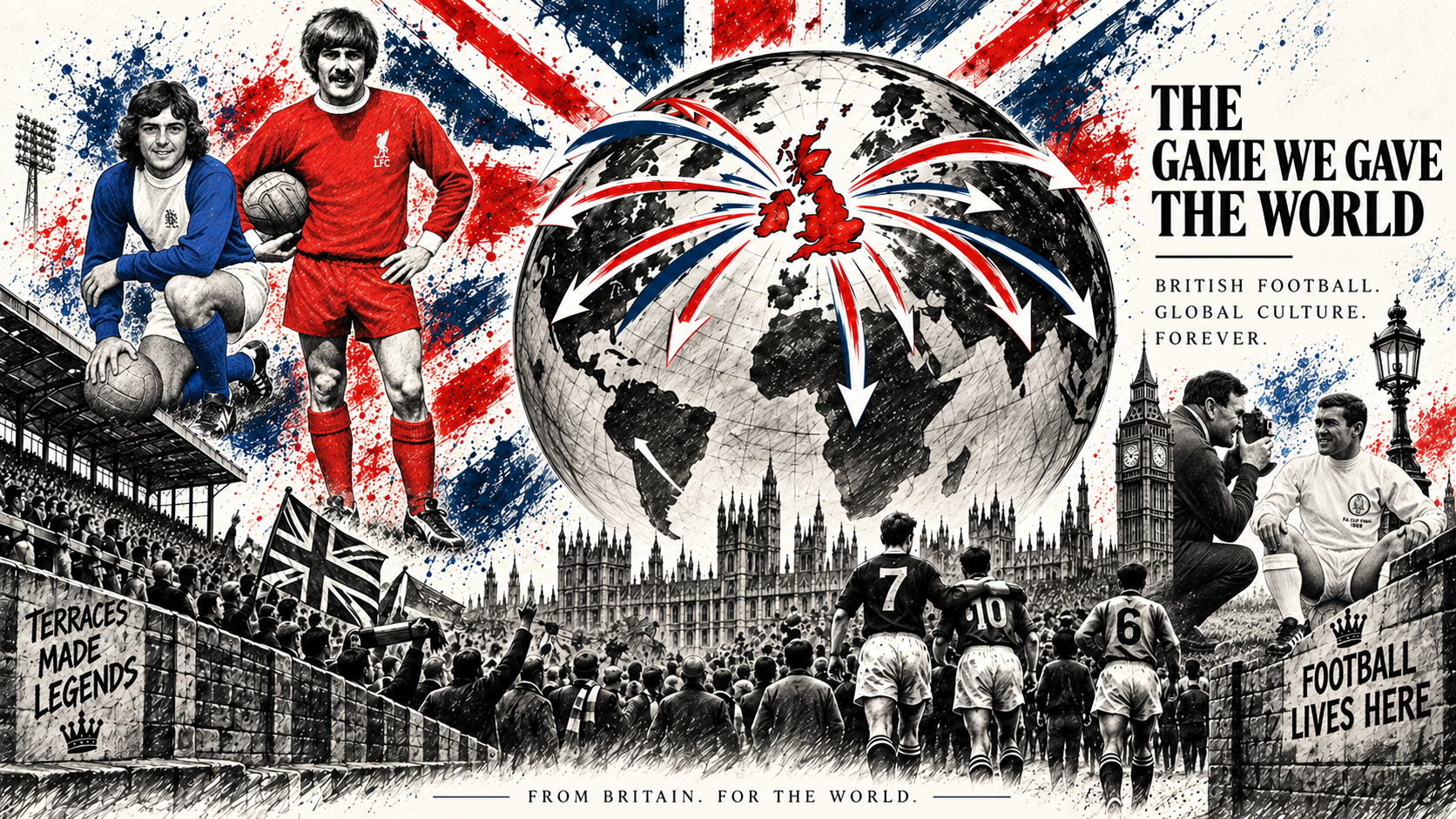

When Bob Paisley succeeded Bill Shankly at Liverpool in 1974, he inherited far more than a football team. He inherited a culture, a standard and a club preparing to dominate Europe. Liverpool’s relationship with British football boot maker Stylo Matchmakers also continued into the 1974/75 season — placing the brand inside one of the most important transitions in English football history.

In the summer of 1974, Liverpool changed forever.
Bill Shankly, the man who had rebuilt the club and transformed Anfield into one of football’s great strongholds, announced his retirement.
Replacing him looked almost impossible.
Liverpool did not search Europe for a glamorous name.
They looked along the bench.
Bob Paisley was already there.
Quiet, knowledgeable and initially reluctant to take the job, Paisley would go on to become one of the most successful managers British football has ever produced.
And as Liverpool entered the Paisley era, Stylo Matchmakers remained part of the football landscape around the club.
That connection gives Stylo something modern brands cannot manufacture.
It was there.
From County Durham to Anfield
Bob Paisley was born in Hetton-le-Hole, County Durham, in 1919, into the mining communities of the North East.
His route into professional football was very different from the carefully engineered careers of the modern game.
After playing for Bishop Auckland, Paisley joined Liverpool in 1939.
Then history intervened.
The outbreak of the Second World War meant his Liverpool career was interrupted almost before it had begun.
When competitive football returned, Paisley became an important member of the Liverpool side that won the 1946/47 First Division championship, the club’s first league title for 24 years.
But his greatest contribution to Liverpool was still decades away.
After retiring as a player, Paisley stayed at Anfield.
Coach.
Physiotherapist.
Tactician.
Assistant.
Football man.
He learned the club from virtually every possible angle.
That mattered.
Shankly built it. Paisley took it further.
When Bill Shankly arrived in 1959, Liverpool were a Second Division club.
Shankly changed everything.
But he did not do it alone.
Behind him developed one of football’s great coaching structures.
Bob Paisley.
Joe Fagan.
Reuben Bennett.
The famous Liverpool Boot Room became part meeting room, part football laboratory and part university.
Ideas were discussed.
Players were analysed.
Problems were solved.
Football remained simple.
When Shankly unexpectedly retired in 1974, Paisley was therefore not an outsider trying to understand what Liverpool had become.
He had helped build it.
Liverpool’s next manager was already inside the building.
Stylo Matchmakers and Liverpool in 1974
The same period also sits firmly within the history of Stylo Matchmakers.
During the 1960s and 1970s, Stylo had established itself among the recognisable British football boot names of the era.
Its boots became associated with some extraordinary footballers.
Pelé.
George Best.
Kevin Keegan.
Billy Bremner.
And during Liverpool’s transition from Shankly to Paisley, the club’s relationship with Stylo Matchmakers continued into the 1974/75 season.
That distinction matters.
There is no need to exaggerate what a football boot contributed to Liverpool’s success.
Boots did not create Bob Paisley.
They did not create Kevin Keegan.
And they did not create Liverpool Football Club.
But they were part of the equipment worn by footballers competing during one of the game’s defining periods.
For a heritage football brand, that is the story.
Stylo was not looking backwards at history.
Stylo was there while it was happening.
Bob Paisley didn’t replace Shankly. He became Bob Paisley.
Paisley’s first season brought no major trophy.
It would be one of the very few quiet years.
What followed was extraordinary.
Across nine seasons as Liverpool manager, Paisley won:
- Six First Division championships
- Three European Cups
- Three League Cups
- One UEFA Cup
- One European Super Cup
- Six Charity Shields, including shared victories
Twenty major honours and recognised trophies followed during a period in which Liverpool became one of the dominant forces in world football.
Most managers would build an entire reputation around one European Cup.
Paisley won three.
The achievement becomes even more remarkable when you consider his personality.
He was not a showman.
He did not build a personal mythology.
He did not need to dominate every room.
Paisley understood football.
He understood players.
And, perhaps most importantly, he understood Liverpool.
The football looked different then
Look at photographs from the period.
Mud.
Terraces.
Leather football boots.
Long hair.
Goalkeepers without gloves that looked like engineering projects.
Managers in tracksuits rather than designer suits.
Football had not yet become the global entertainment machine we recognise today.
The equipment was simpler.
The expectations placed upon it were simple too.
A football boot had to fit.
It had to grip.
It had to survive.
And it had to allow the player wearing it to play.
Stylo Matchmakers belongs to that world.
Not because somebody has recreated the story fifty years later.
Because photographs, players and football history put the brand there.
The Heirship 74
That is why 1974 means something to Stylo Matchmakers today.
The Heirship 74 is not simply a number attached to a football boot.
It points back towards an era when British football boots were being worn in dressing rooms, stadiums and matches that would become part of the sport’s mythology.
An era of Shankly.
Paisley.
Keegan.
European nights.
Packed terraces.
And football before football became a global content industry.
Modern boots must obviously perform for the modern player.
But heritage matters when it is genuine.
The challenge is not to reproduce 1974.
It is to carry something from it forward.
Nine years that changed Liverpool
Paisley eventually stepped down as Liverpool manager in 1983.
Joe Fagan succeeded him, maintaining the continuity that had become one of Liverpool’s greatest strengths.
Paisley remained connected to Liverpool afterwards, the club having effectively become his life’s work.
He died in 1996, aged 77.
By then his place in football history was secure.
Yet statistics only tell part of his story.
Six league titles.
Three European Cups.
Twenty honours.
They explain what Paisley achieved.
They do not quite explain the man.
The photographs often do that better.
Paisley standing alone on the terraces.
Paisley inside Anfield.
Paisley smiling beside European silverware.
No theatre.
No manufactured image.
Just a football man who became one of the greatest managers the game has produced.
Stylo Matchmakers was part of that football world
For Stylo Matchmakers, the significance of the Paisley connection is not about trying to claim Liverpool’s achievements.
Those belong to Paisley, his players and Liverpool Football Club.
The importance is simpler.
Stylo Matchmakers occupied the same football world.
The brand’s history crosses clubs, players and managers who shaped British football.
That history includes some of the greatest footballers ever to play the game.
And it reaches into an extraordinary period at Liverpool when one legendary manager stepped aside and another quietly took his place.
Bill Shankly had transformed Liverpool.
Bob Paisley would take them across Europe.
And in 1974, as one era became another, Stylo Matchmakers was already part of the story.


