

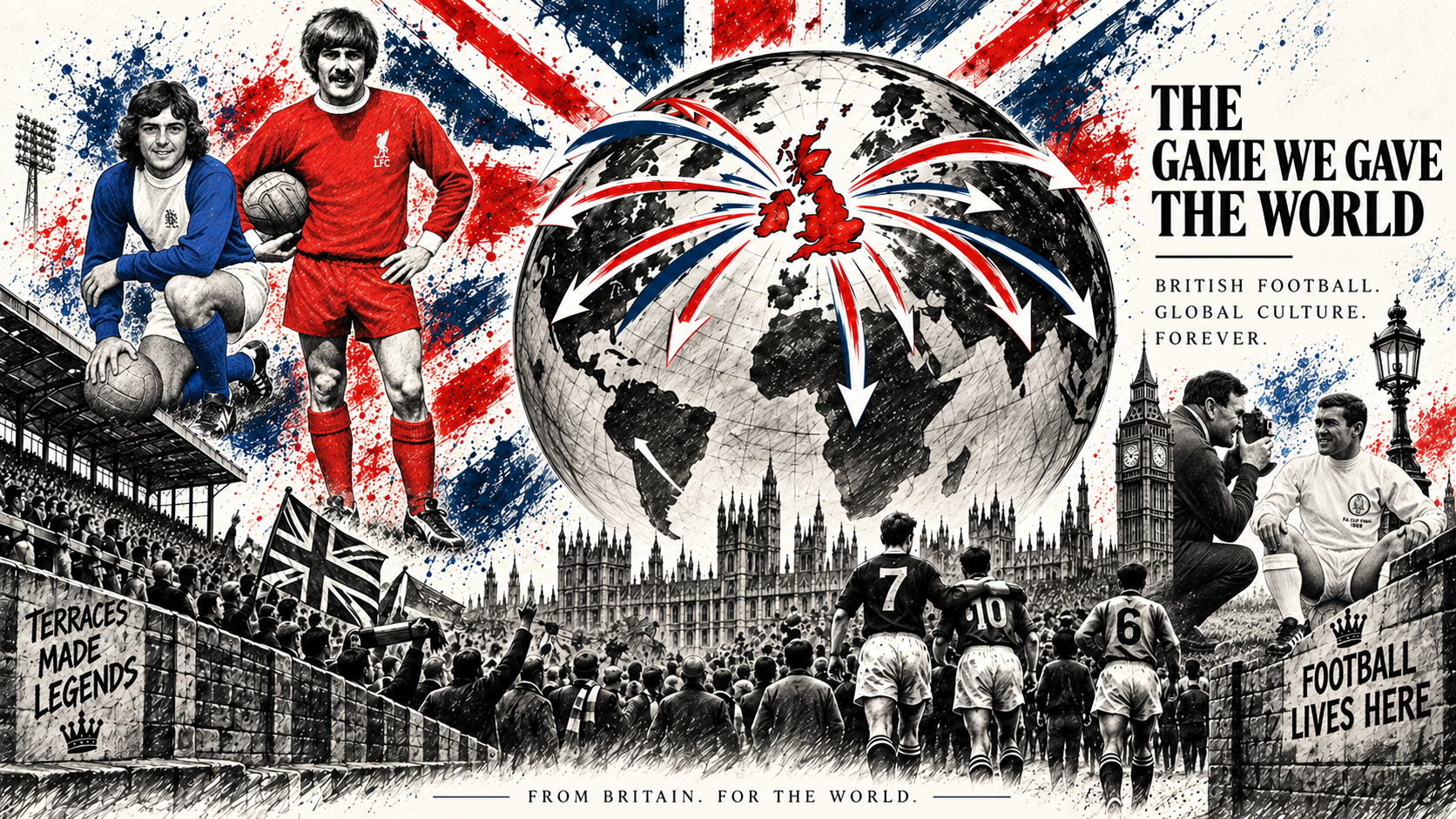

Forty-four days at Leeds introduced Brian Clough to Stylo Matchmakers. What followed at Nottingham Forest became one of football’s greatest revolutions.
Most brand stories begin with a meeting.
This one began with a sacking.
Brian Clough arrived at Leeds United in July 1974 and was gone 44 days later.
Football remembers the arguments, the hostility and the spectacular collapse of a managerial appointment that never stood much chance of working.
Stylo Matchmakers remembers something else.
Leeds United were associated with Stylo during the period, introducing Clough to the British boot brand already worn by some of the biggest players and teams in the game.
Clough liked the boots.
When he took charge of Nottingham Forest in January 1975, he encouraged Stylo to follow him.
Leeds thought those 44 days were the end of the story.
They were only the prologue.
Clough Arrives at Forest
Nottingham Forest were not champions waiting to be awakened.
They were a Second Division club drifting through the middle of the table.
Clough saw something others did not.
He always did.
He began reshaping the culture, expectations and personality of the club. When Peter Taylor rejoined him in 1976, one of football’s great managerial partnerships was restored.
Clough supplied the authority.
Taylor found the players.
Together, they turned overlooked footballers into champions.
Forest won promotion to the First Division in 1977.
Most newly promoted clubs aim to survive.
Clough aimed higher.
Much higher.
Champions of England at the First Attempt
In their first season back in the top flight, Nottingham Forest became champions of England.
They finished seven points ahead of Liverpool in an era when a victory was worth only two.
Forest also won the League Cup, defeating Liverpool in a replay at Old Trafford.
Promoted one year.
Champions the next.
It remains one of the most extraordinary achievements in English football.
Clough did not assemble his team from an endless list of global superstars. He built it around players who had been discarded, underestimated or misunderstood elsewhere.
Peter Shilton.
Kenny Burns.
Larry Lloyd.
Martin O’Neill.
John Robertson.
Ian Bowyer.
Tony Woodcock.
Viv Anderson.
Clough and Taylor did not merely buy talent.
They recognised value before everybody else saw it.
Then they gave those players belief.
Viv Anderson: A Forest Pioneer in Stylo
Viv Anderson became one of the defining players of Clough’s Nottingham Forest.
Quick, athletic and composed, he developed into an outstanding modern full-back before football had started using the term.
Anderson was part of the side promoted in 1977.
He won the First Division title in 1978.
He became a two-time European champion.
And he did it wearing Stylo Matchmakers during his Forest career.
His importance, however, extended far beyond club football.
On 29 November 1978, Anderson became the first Black footballer to represent England at senior international level.
He walked onto the Wembley pitch carrying the expectations of his country and the significance of a moment much larger than one match.
Anderson faced appalling racism during his career. He was abused from terraces and targeted because of the colour of his skin.
He kept playing.
Kept winning.
Kept moving forward.
That makes Viv Anderson more than a Stylo legend.
It makes him a British football pioneer.
Years later, Anderson would become Sir Alex Ferguson’s first signing at Manchester United. He would also wear Stylo again at the PlayOn event in Hong Kong sponsored by the brand.
Forest.
England.
Manchester United.
Hong Kong.
The story travelled, but the boots remained part of it.
From England to Europe
Winning the league gave Nottingham Forest entry into the European Cup.
Their first opponents were Liverpool—the reigning European champions.
Forest beat them.
That result announced that Clough’s side were not entering Europe to enjoy the occasion.
They intended to win it.
Forest reached the 1979 European Cup final in Munich, where they faced Malmö.
By then, Clough had made the signing that broke British football’s transfer barrier.
Trevor Francis.
Trevor Francis: The Million-Pound Matchmaker
Trevor Francis became British football’s first million-pound player when he joined Forest from Birmingham City in 1979.
The fee created headlines.
Clough tried to reduce the pressure.
Francis answered it on the pitch.
Because of European eligibility rules, his continental debut for Forest came in the biggest match of all.
The European Cup final.
Shortly before half-time, John Robertson reached the left-hand side and delivered a cross towards the far post.
Francis launched himself at it.
Header.
Goal.
Nottingham Forest 1–0 Malmö.
European champions.
His first European appearance for the club had ended with the winning goal in the European Cup final.
That is not making an entrance.
That is kicking the door off its hinges.
Francis became another great player within the Stylo Matchmakers story—a footballer with speed, intelligence, individuality and the courage to carry an enormous price tag.
The most expensive player in British football had delivered the most valuable goal in Nottingham Forest’s history.
Champions Again
Winning the European Cup once should have been the end of the miracle.
Clough’s Forest won it again.
In 1980, they reached a second consecutive final, this time facing Hamburg at the Santiago Bernabéu Stadium in Madrid.
John Robertson scored.
Forest defended.
Peter Shilton refused to concede.
Nottingham Forest won 1–0.
Back-to-back European champions.
A club that had been playing Second Division football three years earlier had conquered Europe twice.
Forest have won the English league once.
They have won the European Cup twice.
Read that again.
Modern football tells us history belongs to the richest clubs.
Brian Clough proved otherwise.
Eighteen Years of Clough
Clough remained at Nottingham Forest until 1993.
Across 18 years, he led the club to:
- One First Division championship
- Two European Cups
- Four League Cups
- One European Super Cup
- Promotion from the Second Division
- An FA Cup final
- A place in football immortality
But lists do not entirely explain what he built.
Clough made Nottingham Forest believe it could stand alongside Liverpool, Bayern Munich, Real Madrid and the other giants of European football.
He made discarded players feel ten feet tall.
He made a provincial club the centre of the football world.
And he did it his way.
The Clough Revolution
Clough was charismatic, confrontational and impossible to ignore.
But the noise sometimes disguises the intelligence.
His football was based on simplicity.
Keep the ball.
Pass it properly.
Do not panic.
Trust good players.
He understood people as well as football. Some players needed an arm around the shoulder. Others needed challenging. A few needed reminding who was in charge.
All of them knew there was only one gaffer.
Clough did not follow football fashion.
He made football follow him.
That is why Stylo Matchmakers fitted.
The brand was not built for players or managers who wanted to disappear into the crowd.
It was worn by people with identity.
George Best.
Pelé.
Kevin Keegan.
Billy Bremner.
Viv Anderson.
Trevor Francis.
And Brian Clough’s Nottingham Forest.
This Was Not Nostalgia
Stylo Matchmakers did not discover Nottingham Forest’s European history decades later and attach itself to the photographs.
The brand was there.
It followed Clough from the wreckage of Leeds to the beginning of something extraordinary at the City Ground.
It was worn by Viv Anderson during his Forest career.
It became connected with Trevor Francis, the man whose goal made Forest champions of Europe.
Years later, Anderson pulled on Stylo again in Hong Kong.
That is not retro marketing.
It is continuity.
A Second Division club became champions of England.
Then champions of Europe.
Then champions of Europe again.
Modern football would tell you it should never have happened.
Brian Clough did it anyway.
Clough. Forest. Stylo Matchmakers.
The revolution was worn in black.


