

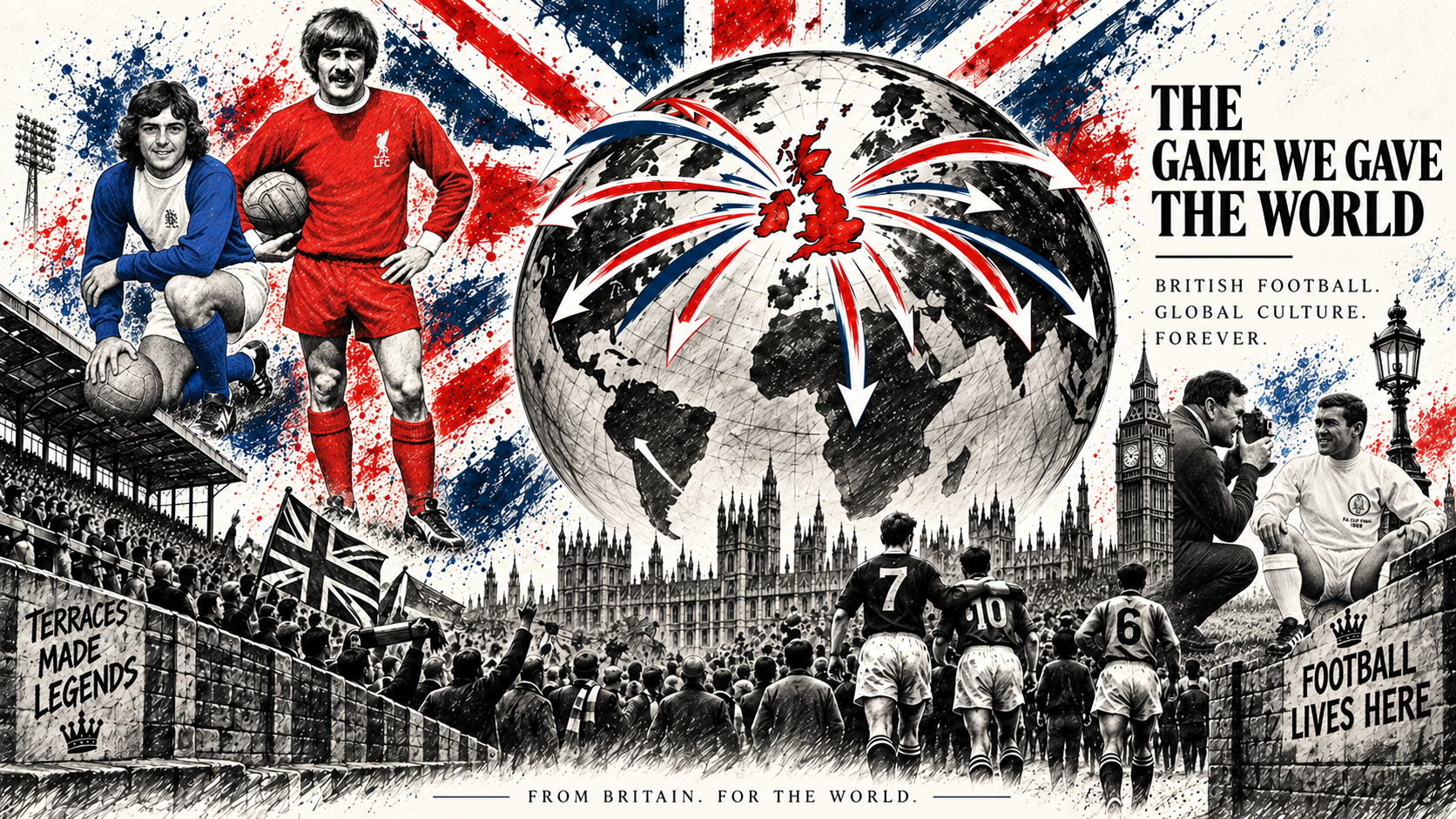

There are footballers remembered for goals. Others for trophies. Some for a single afternoon that entered folklore.
Tommy Smith was remembered for presence.
Before a ball had been kicked, opponents knew he was there.
Born in Liverpool in 1945 and raised in the shadow of Anfield, Smith became one of the defining figures of the club’s transformation from ambitious English side into a European power. Across 638 Liverpool appearances and 48 goals, he won league championships, FA Cups, UEFA Cups and the European Cup. Only a small number of players have represented Liverpool more often.
Yet reducing Smith to Liverpool’s resident hard man misses half the story.
He could tackle, intimidate and compete with almost frightening intensity, certainly. But Smith could also read a match, distribute the ball, move between centre-half and full-back and contribute goals. Contemporary accounts described a defender whose reputation for physicality sometimes obscured how accomplished a footballer he actually was.
That combination makes his association with Stylo Matchmakers particularly fitting.
This was football before boots became spaceships.
Leather. Studs. Mud. Character.
And Tommy Smith.
From the streets around Anfield to Liverpool’s first team
Smith was not imported into Liverpool’s culture.
He was part of it.
He grew up supporting the club and joined Liverpool’s ground staff in 1960 while still only 15. Within months he was playing reserve-team football.
Bill Shankly recognised immediately what he had.
Shankly’s description of Smith became almost as famous as the player himself:
“He wasn’t born, he was quarried.”
It is difficult to find a better description.
Smith made his senior Liverpool debut against Birmingham City on 8 May 1963, shortly after his 18th birthday. His breakthrough came during the 1964–65 season and ended with something Liverpool had never previously achieved — winning the FA Cup. Smith started the final as Leeds United were beaten 2–1 after extra time at Wembley.
For a local teenager who had grown up close enough to Anfield to understand exactly what the club meant to its community, that was only the beginning.
The defender who became part of Shankly’s machine
Liverpool followed the FA Cup by winning the First Division championship in 1965–66.
Smith had become virtually immovable.
Three of the following four league seasons saw him feature in every league fixture. This was before squad rotation, five substitutions and sports-science-managed workloads. Defenders played hurt. Pitches deteriorated. Tackles arrived late. Matches became wars of attrition.
Smith survived because he was built for it.
But there was intelligence behind the aggression.
He could play across the defence, carry the ball, pass accurately and score. His 48 Liverpool goals are a considerable return for a defender of that period. Despite the mythology surrounding his tackling, Liverpool’s own historical record notes that Smith was dismissed only once in his top-flight career — and that came after an argument with referee Clive Thomas rather than a violent challenge.
The caricature is therefore wrong.
Tommy Smith wasn’t simply Liverpool’s enforcer.
He was an elite footballer who happened to frighten people.
Captain of Liverpool
In 1970, Shankly appointed Smith Liverpool captain.
That matters.
Shankly was rebuilding his great Liverpool side, gradually moving beyond the generation that had taken the club out of the Second Division and towards a younger team containing figures such as Kevin Keegan and Steve Heighway.
Smith was one of the bridges between those Liverpool generations.
His captaincy reached its peak in 1972–73.
Liverpool won the First Division title and then defeated Borussia Mönchengladbach to win the UEFA Cup — the first European trophy in the club’s history.
The man lifting it was Tommy Smith.
A boy from the streets around Anfield had become the first Liverpool captain to raise a major European trophy.
It should be remembered whenever Smith is reduced to anecdotes about tackles.
He wasn’t simply protecting Liverpool’s great teams.
He was leading one.
Tommy Smith, Kevin Keegan, Steve Heighway — and the Stylo era
This is where the Stylo Matchmakers story becomes particularly interesting.
By the early-to-mid 1970s, Stylo was operating in a football culture populated by some extraordinary characters. The brand’s heritage includes players such as George Best, Pelé, Kevin Keegan and Steve Heighway, while its relationship with major clubs placed Stylo directly inside one of British football’s great periods.
Tommy Smith fits that history almost perfectly.
Look at the football boot of his generation and you see something fundamentally different from today’s market.
There were no knitted uppers.
No fluorescent colourways.
No launch campaigns built around what a boot would look like on social media.
A boot was principally expected to survive ninety minutes of professional football.
Smith’s football was about reliability, toughness and performance rather than theatre.
That is why the historical Stylo imagery has such power today.
The footballer and the product look as though they belong together.
The Heirship Seventy Four
The modern Stylo Matchmakers Heirship Seventy Four draws from that world.
It should not be positioned as nostalgia for nostalgia’s sake.
The point is not simply that old football boots looked beautiful.
It is what they represented.
The long tongue.
The black leather.
The unmistakable silhouette.
The simplicity.
A football boot that looked like a football boot.
The Heirship Seventy Four carries that design language into the modern Stylo story — a link between the football culture represented by Smith, Keegan and Heighway and a generation increasingly tired of football products that look indistinguishable from one another.
Smith gives that story something advertising departments cannot manufacture.
Authenticity.
Losing the captaincy
The Tommy Smith story also becomes much more interesting when things stopped going perfectly.
Shortly after the triumph of 1973, Smith lost the Liverpool captaincy and his place in the team.
The armband passed to Emlyn Hughes.
Their relationship was famously difficult, and Smith seriously considered leaving Liverpool for Stoke City. He was approaching 30, younger defenders were emerging, and a career that had appeared permanently intertwined with Liverpool suddenly seemed to be moving towards its conclusion.
It would have been an understandable moment to leave.
Smith stayed.
He fought his way back.
And that decision eventually produced the image that defined his career.
Wembley again — 1974
Smith remained an important member of the Liverpool side that reached the 1974 FA Cup final.
Newcastle United were dismantled 3–0 at Wembley as Liverpool won the trophy for only the second time.
That summer Shankly stunned football by retiring.
Bob Paisley inherited the team, and Liverpool began evolving again.
Players such as Phil Thompson and Phil Neal increasingly occupied defensive positions. Smith was no longer guaranteed his place.
Most football careers gradually disappear at this stage.
Smith’s had one enormous chapter left.
Europe again
Liverpool won another league championship and UEFA Cup double in 1975–76.
Smith remained involved, even playing at left-back during the UEFA Cup final against Club Brugge.
But by the beginning of 1976–77, Smith believed the end had arrived.
He announced that he intended to retire.
By March he had barely appeared in the league.
Then football performed one of those tricks that makes sporting history impossible to script.
Phil Thompson was injured.
Tommy Smith was needed again.
The veteran returned to the side for the decisive final stretch of Liverpool’s championship campaign.
And Liverpool reached the European Cup final.
Rome, 25 May 1977
Liverpool had never won the European Cup.
Their opponents in Rome were familiar: Borussia Mönchengladbach, the German side Liverpool had beaten in the UEFA Cup final four years earlier.
Terry McDermott gave Liverpool the lead.
Allan Simonsen equalised.
The score was 1–1.
Then came a corner.
Steve Heighway delivered it from the left.
Kevin Keegan’s movement attracted defenders.
And into the space moved a 32-year-old Scouser who had originally planned to retire.
Tommy Smith rose and headed Liverpool into a 2–1 lead.
Phil Neal later converted a penalty.
Liverpool won 3–1.
For the first time, the European Cup belonged to Liverpool Football Club.
Of all the tackles, arguments, trophies and battles Smith experienced across his career, this became his defining image.
The supposedly ageing defender.
The local boy.
The former captain.
The man who had almost left.
Rising above everyone in Rome.
Bang.
2–1.
History changed.
Why that goal means more than a goal
Football history is full of great players scoring important goals.
Smith’s was different because of everything that came before it.
He had lost the captaincy.
He had lost his guaranteed place.
He had contemplated leaving.
Younger players had started replacing him.
He had announced his intention to retire.
Then, at the biggest moment Liverpool had experienced in European football, the club turned back towards one of the men who had helped build it.
And Smith delivered.
Liverpool teammate Kevin Keegan later praised Smith for extracting everything possible from his ability — one reason his career endured for so long.
That may be a better description of Smith than “hard man.”
He emptied the tank.
Every match.
Every season.
For Liverpool.
One more year
Rome was supposed to provide the perfect ending.
Smith changed his mind and stayed for another season.
Liverpool reached the European Cup final again in 1978, but Smith missed the victory over Club Brugge after suffering the most Tommy Smith injury imaginable: he dropped a heavy hammer on his foot while doing DIY and broke his toe.
That summer his Liverpool career finally ended.
The numbers were extraordinary:
638 appearances.
48 goals.
Four league championships.
Two FA Cups.
Two UEFA Cups.
European Cup glory.
UEFA Super Cup success.
And, remarkably for someone whose reputation rested partly upon physical intimidation, just one England appearance, against Wales in 1971.
He was also appointed MBE in 1978.
From Anfield to Swansea
Smith left Liverpool in 1978 and joined Swansea City, then managed by another former Liverpool favourite, John Toshack.
Even in the closing stages of his career, Smith’s competitive instincts remained intact.
He helped Swansea earn promotion before eventually stepping away from playing.
His association with Liverpool, however, never really ended.
There were later roles around football, including coaching, speaking and newspaper work, but to Liverpool supporters he remained what he had always been:
The Anfield Iron.
More than a hard man
Football has sanitised many of its former characters.
Smith should not be sanitised.
His confrontational side was real.
His feuds were real.
His tackles were real.
His intimidating reputation was certainly real.
But concentrating solely upon that misses what made him special.
You don’t play 638 times for Liverpool because you can tackle.
You don’t captain Liverpool to its first European trophy because you’re frightening.
And you don’t survive the transition from Shankly to Paisley, win championships across different Liverpool sides and score in a European Cup final at 32 unless you can seriously play football.
Tommy Smith was hard.
But Tommy Smith was also very, very good.
Tommy Smith and Stylo Matchmakers — football before the marketing department
That is ultimately why Smith belongs so naturally inside the Stylo Matchmakers story.
Stylo’s heritage comes from an era when footballers looked different, spoke differently and often had a completely different relationship with supporters.
They were not content creators.
They were not global lifestyle properties.
They were footballers.
Smith looked like Liverpool.
He sounded like Liverpool.
He played as though representing Liverpool mattered.
And when football’s biggest night arrived in Rome in 1977, the local lad was still standing.
The Heirship Seventy Four is our connection to that world.
Not because football should return to 1974.
It shouldn’t.
But because some things from that era are worth protecting:
identity.
character.
craftsmanship.
loyalty.
football boots that actually look like football boots.
And footballers nobody could mistake for anybody else.
Tommy Smith was certainly one of those.
The Anfield Iron lives on
There will never be another Tommy Smith.
There probably couldn’t be.
Modern football has changed too much.
But that is precisely why his story matters.
Before football became an entertainment industry, before players became global brands and before boots became marketing platforms, there were men like Smith walking down the tunnel at Anfield.
Black boots.
Red shirt.
No nonsense.
And an opposition forward wondering whether somebody else might fancy receiving the next pass.
Tommy Smith didn’t merely belong to Liverpool’s great era.
He helped create it.
And that is why the Anfield Iron deserves his place in the history of Stylo Matchmakers.
Scott Michaels, Stylo Matchmakers
“Tommy Smith represents almost everything I love about the history of Stylo Matchmakers.
He wasn’t manufactured. He wasn’t polished into a football personality. He was a Liverpool lad who fought his way from the ground staff to captaining his club, lifting Liverpool’s first European trophy and eventually scoring one of the most important goals in its history.
But I think calling Tommy simply a hard man does him a disservice. You don’t play 638 games for Liverpool through the Shankly and Paisley eras unless you can play.
That’s what makes the Stylo connection special. Tommy sits in the same period of our history as Kevin Keegan, Steve Heighway and some of the greatest characters British football produced.
Stylo isn’t interested in pretending football history began when marketing departments discovered it.
We were there.
Tommy Smith was there.
And the Heirship Seventy Four keeps a little piece of that football alive.”
— Scott Michaels, Owner, Stylo Matchmakers


